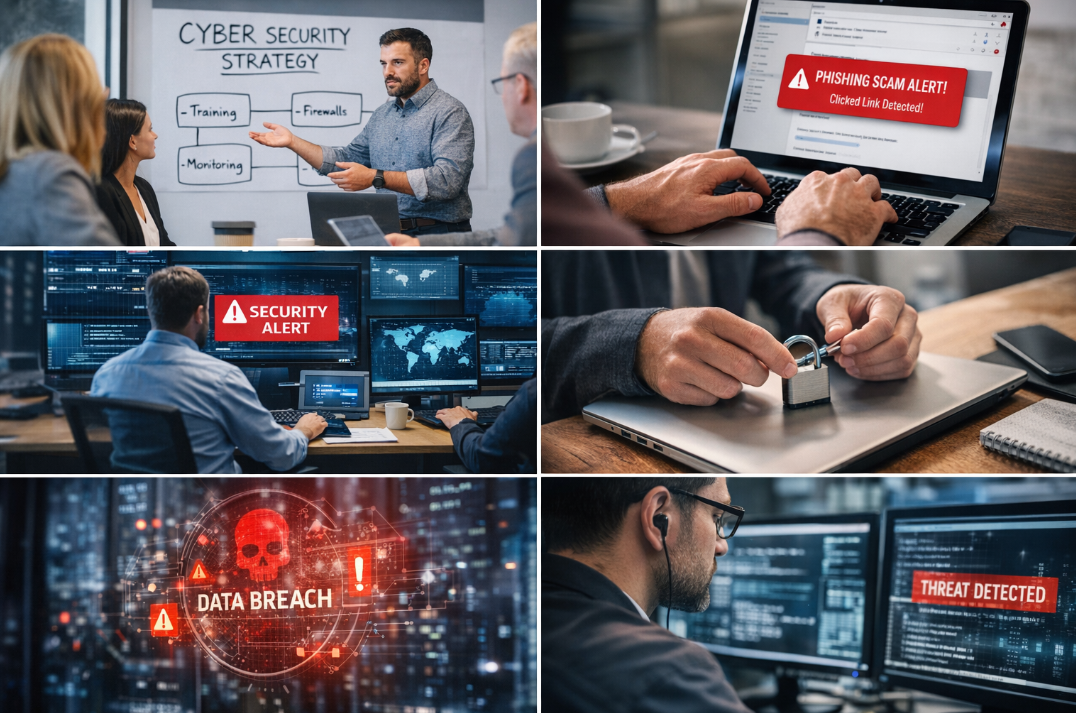
When people talk about security at work, the conversation often gets fuzzy pretty fast. Someone says IT handles it. Someone else says the software company should handle it. Then a manager assumes the security tool they bought last year is covering everything. And for a while, maybe that feels good enough. But when something goes wrong, like a phishing email gets clicked, a laptop goes missing, or files suddenly become unavailable, the question gets very real.
Let’s Get Started!
(888) 684-2448
Who Is Actually In Charge Of Protecting Your Business Systems?
At IS Technology, we see this confusion more often than people might expect. A business adds new tools, new users, and new devices over time. Bit by bit, the system grows. But the responsibility does not always grow in a clear way. It spreads out. Some of it sits with leadership. Some with internal staff. Some with outside providers. Some with employees who probably do not even realize they are part of the security picture. That is usually where the trouble starts.
The truth is, Protecting Your Business Systems is not one person’s job. It is not only your IT person’s job either. It is a shared responsibility. That may sound a little broad, maybe even frustrating, but it is still true. A business needs clear ownership, good habits, the right tools, and people who understand what they are supposed to do. Without that, gaps open up. Sometimes small gaps. Sometimes really costly ones.
This article breaks that down in a practical way. We will look at what Protecting Your Business Systems really includes, who should own which parts, where businesses tend to make mistakes, and how a company can build a more reliable security setup without making everything feel overly technical or impossible to manage.
Why Does Protecting Your Business Systems Matter So Much Now?
Years ago, some businesses thought security mostly meant having antivirus and locking the office door at night. That was not perfect even then, but now it is definitely not enough. Business operations live inside systems now. Email, invoices, payroll, file storage, customer records, inventory, scheduling, communication, remote access, cloud apps. It all runs through digital systems.
So when those systems are weak, the business is weak too.
That is why Protecting Your Business Systems matters so much. It is not only about stopping hackers, though that matters. It is also about keeping daily work running. It is about trust. It is about keeping your team productive and your customers confident. A security problem can become a business problem very fast.
Here is what weak business system security can lead to:
- lost access to files or applications
- stolen customer or employee data
- fake invoices or payment fraud
- downtime that slows or stops operations
- damaged reputation
- compliance trouble
- expensive recovery work
- stress across the whole company
Sometimes people think these problems only happen to large companies. I understand why. Big breaches make the news. But smaller businesses get targeted too, and honestly, they are often easier targets because they have fewer controls in place.
That is one reason small business cybersecurity support matters more than ever. Smaller teams usually do not have time to manage every security detail alone, and attackers know that.
What Counts As Business Systems, Exactly?
This is a good place to slow down for a second. Before you can talk about ownership, you need to know what you are protecting.
When we say business systems, we mean the digital tools, devices, and processes your company relies on to operate. That includes obvious things, but also some less obvious ones.
Your business systems may include:
- desktops and laptops
- servers
- cloud platforms
- email systems
- phones and mobile devices
- network hardware
- remote access tools
- software for accounting, HR, CRM, and operations
- file storage systems
- backup systems
- printers and connected office devices
- user accounts and passwords
- security tools and logs
A lot of people picture one big “IT system” in their head, but in real life it is more like a web. Everything connects. That is why business systems protection has to be broader than just one tool or one department.
A password problem can become a file problem. A file problem can become a customer problem. A weak laptop can become a network problem. It all ties together.
Who Is Responsible For Protecting Your Business Systems?
The short answer is this: responsibility is shared, but ownership must still be clear.
That sounds a little contradictory at first. It is not, really.
Protecting Your Business Systems should involve:
- business owners and executives
- internal IT staff
- outside IT partners
- cybersecurity providers
- department managers
- everyday employees
- vendors and software providers
The mistake many businesses make is assuming “shared responsibility” means “someone else will handle it.” That is where things go sideways. Shared responsibility only works when each group knows what part belongs to them.
Leadership owns direction and accountability. IT owns technical controls and maintenance. Security partners may own monitoring and response. Employees own everyday safe behavior. Vendors may own parts of their platforms. Everyone has a piece.
At IS Technology, we usually tell clients this: if no one can clearly say who owns a security task, then that task probably is not being handled the way it should be.
Let’s Get Started!
(888) 684-2448

What Should Business Owners And Leaders Be Responsible For?
This part is bigger than some people think.
Owners and leaders do not need to configure firewalls themselves or chase patch schedules. That is not usually their role. But leadership is still deeply responsible for Protecting Your Business Systems because they set priorities, budgets, policies, and expectations.
If leadership treats security as optional, the whole company feels it.
Leaders are usually responsible for:
- approving security budgets
- choosing trusted technology partners
- setting company-wide expectations
- making security part of business planning
- deciding what level of risk is acceptable
- supporting training and policy enforcement
- asking the right questions about system health
This ties directly into business system risk management. Risk is not just a technical issue. It is a business decision. Leaders decide what the company will invest in, what it will delay, and what level of exposure it is willing to carry.
I think this is where some businesses get stuck. They assume security decisions are too technical for leadership. But leadership does not need to know every technical detail. They just need to take ownership of the outcome.
A leader should be able to answer questions like:
- What are our most important systems?
- Who supports them?
- How are we protecting access to them?
- Do we have backups?
- What happens if email goes down tomorrow?
- Who do we call if something suspicious happens?
Those are leadership questions, not just IT questions.
What Are The System Security Responsibilities Of Internal IT?
Internal IT usually carries a large part of the day-to-day load. This is where many of the practical controls live. If leadership owns business risk and direction, internal IT often owns execution.
Typical system security responsibilities for internal IT include:
- managing user accounts
- controlling permissions
- keeping systems updated
- maintaining devices
- reviewing system health
- coordinating backups
- supporting secure remote access
- configuring security tools
- handling basic incident escalation
- documenting system changes
This is a huge part of business systems maintenance. Security does not sit separate from maintenance. They overlap all the time. Systems that are ignored, outdated, or poorly documented tend to become security problems eventually.
Internal IT may also support:
- business systems monitoring
- network monitoring for businesses
- device encryption
- device inventory
- patch management
- software approval and removal
- access reviews
In some businesses, internal IT handles almost all of this alone. In others, they work with an outside partner. Either way, they need enough time, authority, and structure to do the job well.
One issue I see pretty often is that internal IT gets pulled into constant help desk work and never has enough room left for preventive work. Tickets pile up. Password resets keep coming. Printers break. People need access. Then security improvements keep getting delayed because there is always something louder happening.
That is understandable. It is also risky.
What Role Does An Outside IT Partner Play In Protecting Business Systems?
A good outside partner can fill a lot of gaps, especially for companies without a large in-house team. They may handle infrastructure support, device management, account controls, patching, backups, vendor coordination, and strategic planning.
This is often where managed security for business systems starts to come into the conversation.
An outside IT partner may help with:
- remote monitoring and management
- patching and updates
- backup oversight
- cloud administration
- security policy support
- endpoint management
- user onboarding and offboarding
- system documentation
- vendor support coordination
- general cybersecurity for business systems
That said, businesses still need clarity here. Some owners assume their IT provider is covering every part of security when the provider may only be covering general support and maintenance. That is a dangerous assumption.
Not every IT provider handles advanced threat detection for business systems. Not every provider manages security operations around the clock. Not every provider handles incident response deeply. Some do. Some do not. The scope matters.
At IS Technology, we think businesses should ask direct questions, even if they feel repetitive:
- What exactly are you monitoring?
- Do you review alerts in real time?
- Who responds to suspicious activity?
- Are backups tested?
- Are user permissions reviewed?
- What is not included?
That last question matters a lot. Maybe the most.
What Part Do Employees Play In Protecting Business Systems?
A very big part, honestly.
People sometimes talk about employees as the “weakest link.” I understand what that phrase is trying to say, but I do not love it. It feels too dismissive. Employees are not just risks. They are also a major line of defense when they are trained and supported well.
Every employee affects Protecting Your Business Systems through daily behavior.
Employees help protect systems when they:
- use strong passwords
- follow access rules
- report suspicious messages
- avoid unsafe downloads
- lock devices when away
- use approved tools
- handle data carefully
- follow remote work policies
- ask questions when something feels off
This connects directly to identity and access management for businesses and access control for business systems. A lot of system risk is really user risk. Who has access? How much access? How often is it reviewed? What happens when someone leaves the company? What happens when someone clicks the wrong link?
Security awareness training matters because people are busy. They move fast. They trust what looks familiar. A fake login page only has to work once. A fake invoice only has to fool one person. That is why employee participation is part of real business systems protection, not just an afterthought.
Let’s Get Started!
(888) 684-2448
How Important Is Access Control For Business Systems?
Very important. Maybe one of the most important areas.
Access control for business systems is about making sure the right people have the right access at the right time, and not more than they need. It sounds simple, but it gets messy quickly in real workplaces.
People change roles. Temporary access becomes permanent. Former employees still have old accounts. Shared logins appear because they feel convenient. Vendors get access and nobody reviews it later. These things build up.
Good access control usually includes:
- unique accounts for each user
- least-privilege access
- role-based permissions
- multi-factor authentication
- regular access reviews
- fast offboarding when people leave
- documented approval for elevated access
This is a major part of identity and access management for businesses. If access is loose, everything else becomes harder to protect. Even strong devices and solid networks can be undermined by weak identity controls.
I think this is one of those areas businesses delay because it feels administrative. But it is foundational. You cannot protect systems well if you do not know who can get into them.
What Is Business Systems Monitoring, And Who Should Own It?
Business systems monitoring means watching systems, devices, applications, and activity for signs of problems. Some of those problems are technical failures. Some are security events. Some are both.
Monitoring can include:
- device health alerts
- server performance issues
- failed logins
- suspicious network traffic
- storage failures
- backup failures
- unusual account activity
- malware alerts
- patching failures
- service downtime
In smaller companies, IT staff or an outside provider may handle most of this. In larger or more security-focused environments, this work may be split between IT operations and security teams.
The key point is that someone needs to own the review, escalation, and response process. Alerts by themselves do not protect anything. If no one is reviewing them or acting on them, they are just noise.
This overlaps with network monitoring for businesses too. Monitoring the network helps identify unusual connections, traffic spikes, unauthorized devices, and other signs that something may be wrong.
One thing businesses should ask is not only whether monitoring exists, but whether anyone is actually watching it in a meaningful way. A dashboard can look impressive and still leave you exposed if no one is responding to what it shows.
What About Endpoint Protection For Businesses?
Endpoints are the devices people actually use. Laptops, desktops, servers, mobile devices. They are where users work, which means they are also where a lot of risk enters.
Endpoint protection for businesses usually includes tools and practices designed to protect those devices from malware, ransomware, unauthorized access, and suspicious behavior.
This can include:
- antivirus or endpoint detection tools
- device encryption
- patching and updates
- remote wipe capabilities
- device inventory
- admin control restrictions
- secure configuration standards
Endpoint protection matters because even one compromised device can create bigger problems. A single laptop with bad controls can expose files, credentials, and connected systems.
Who owns this? Usually IT or a managed provider, with input from security teams if there are more advanced tools in place. But users still play a role too. They decide what they click, install, and connect.
This is why protecting business systems cannot be reduced to buying software. The tools matter, yes. But so do configuration, oversight, and user behavior.
How Does Business Network Security Fit Into The Picture?
Business network security is the layer that helps protect how devices and systems connect and communicate. It includes the infrastructure that carries traffic between systems and out to the internet.
This often includes:
- firewalls
- switches and wireless controls
- network segmentation
- VPN setup
- DNS filtering
- intrusion prevention
- secure configuration of remote access
Network security usually belongs to IT infrastructure teams or outside IT partners. In some cases, security specialists may help design and review it, especially if the environment is more complex.
This matters because networks are often where lateral movement happens. An attacker gets in through one point and then moves through connected systems. Strong business network security can slow that down or stop it earlier.
Network controls are not always visible to regular employees, which may be why they get taken for granted. But they are part of the reason a business can function safely in a connected environment.
What Is Threat Detection For Business Systems?
Threat detection for business systems means identifying signs that something harmful may be happening. That can include malware, strange login activity, unauthorized access attempts, suspicious file changes, odd network behavior, or unusual use of user accounts.
Threat detection is more active than just basic monitoring. It is not only seeing that something changed. It is trying to recognize whether that change may be dangerous.
Strong threat detection may include:
- behavioral analysis
- security event review
- suspicious login pattern detection
- unusual device activity alerts
- ransomware indicators
- privilege misuse detection
- cloud account anomaly detection
This is an area where businesses often assume more is happening than really is. They may have tools installed, but no one is actively reviewing security signals in a meaningful way. Or the reviews